


This blog was written by Simon van Dongen, a former ICT Europe volunteer, about his experience visiting the affected area shortly before the recent floods along the Tibet–Nepal border.
I had to gasp for air after I saw the footage of water filling up valleys in northern Nepal. Is this real? How would it feel if I were there now? I could not imagine it. But wait, I was there, two years ago.
My name is Simon van Dongen and I am a human geographer who travelled to Nepal during my studies and did voluntary work for ICT-Europe. In this story I will share my and my girlfriend’s experience of visiting the affected area at the foot of the Himalaya in Nepal before the current natural disaster. Hopefully, this story will contribute to awareness of the dangers associated with high altitude that the Tamang and Sherpa people have to cope with. Also I would like to honour the warm people who we met.
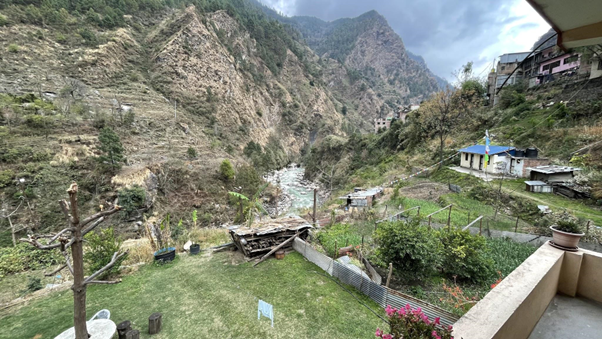
As I wrote in my blog about this journey (link), I had to travel for about eight hours from Kathmandu to Syabrubesi. I arrived in this lively village at the junction of the Langtang Khola and the Trishuli river. I walked down towards the riverside, where there was a street full of homestays. I stayed in a small homestay with only four rooms and a beautiful garden. The Trishuli and Langtang Khola rivers supply fresh drinking water for the people here, as well as the cattle. Additionally, it provides a place for bathing and washing clothes. Living close to the river, which is crucial to their livelihoods, seems so logical but is also risky because the river can grow quickly in the mountains, as the owner told me. Now the village of Syubrabesi is one of the places that suffered the most damage and casualties during the flash floods. Although it is hard to imagine, the hotels I saw and the people I spoke with are probably not there anymore.
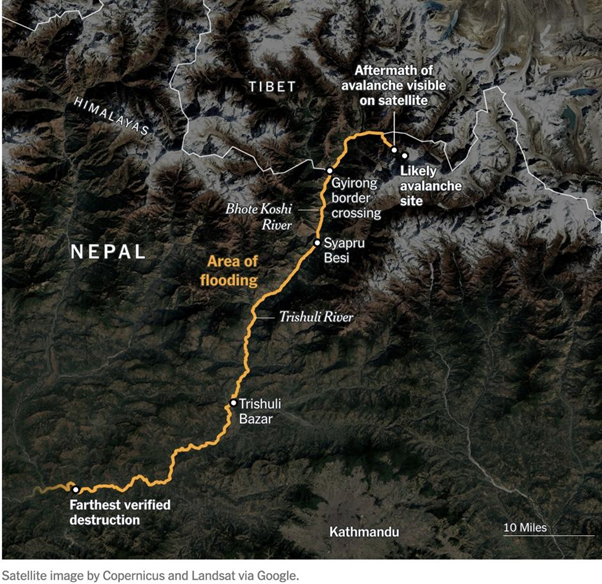
On the given map can be seen what route the flash flood of 2026 took and from where Syabrubesi (spelled as Syapru Besi) was hit. The picture I took in the homestay in Syabrubesi shows the river and the garden.
From Syabrubesi, I entered the Langtang Valley on foot. After three days, we reached Langtang. When we arrived, we saw the village was split in two. At the tea house where we stayed, the owner asked me if he could use my binoculars to see his neighbours on the other side of the village. He looked towards the northern side. There were no houses in the middle, no one started building on top of the former village. A painful history lies down there: a disaster that buried all Langtang’s houses and took all these lives in 2015. While new people started living in Langtang, natural threats at its altitude of 3,500 metres are not holding back.
My girlfriend went to Nepal a year later. She visited the severely hit Trishuli Valley as well. She was in a village called Ling Ling, near Syubrabesi, where she met a friendly homestay owner. He spoke openly about the earthquake in 2015. The entire village evacuated and prayed together that the earthquake would not trigger a landslide from the peaks around them. My girlfriend asked him how he dealt with fear. He answered, “Mindfulness, it helps us be present in the moment, living one day at a time and not letting fear control our lives.” He sat there every morning, observing the sun rising above the enormous peaks.
Around the border between Nepal and Tibet, some of the highest mountains in the world are located. It is a place where Tamang and Sherpa people make their livelihoods from cattle and tourism. However, they are exposed to the dangers associated with high altitude every day. Its inhabitants are in some ways prepared for landslides and rising rivers, but a flash flood of this size, nobody was expecting. I admire the way these people cope with the dangers at high altitude, namely with courage, mindfulness and positivity. Lastly, I sincerely hope that the people my girlfriend and I met in these valleys are okay, but it remains uncertain.
Support Tibetans in their struggle for freedom by donating here!